AI Documentation Starts at the Scene—Not Back at the Station (Part 5 of 9)


.svg)


Documentation will always be secondary to taking care of the patient. That's how it should be — and it's exactly why the patient care report has always come last.
For years, the ePCR got written at the hospital or back at the station, whenever there was finally time. By then, memory has done its work: on back-to-back-to-back calls, the details blur, and what you thought you heard isn't always what was said. Studies have found documentation errors that trace back to exactly this gap.
The fix isn't writing faster after the fact. It's capturing quality data at the point of care — while the call is happening.
The Patient Care Report Has Always Come Last
The problem with memory-based charting isn't effort. Crews work hard to get it right. The problem is that the human memory fades, and it runs together — which procedure, at what time, what the patient actually said. When the EMS patient care report is reconstructed hours later, small errors creep in, and small errors in a legal medical record are not small.
Good EMS charting systems have never struggled to store data. They've struggled to capture it accurately, at the moment it's true.
When You Document From Memory, the Record Suffers
Consider a long-term care transfer. The facility hands you two pages of medications on paper. There's rarely time to copy all of that down by hand during a call, so it gets summarized, approximated, or skipped — and the record to the hospital is thinner for it.
Multiply that across a busy shift and the pattern is clear: the harder the day, the worse the documentation, precisely when accurate patient care reporting matters most.
Moving the ePCR to the Point of Care
AI documentation moves capture to where the information actually lives — the scene. It isn't there to write your chart. It's there to gather what's said and done as it happens and organize it so the record reflects the call accurately.
You can have a normal conversation with the patient while the tool runs in the background, picking up the details. You can photograph a medication list or a page of past medical history at that long-term care facility and let the system read it, instead of transcribing two pages by hand. The result is a more accurate record, built from what really happened rather than what you remember.
How First Due Helps
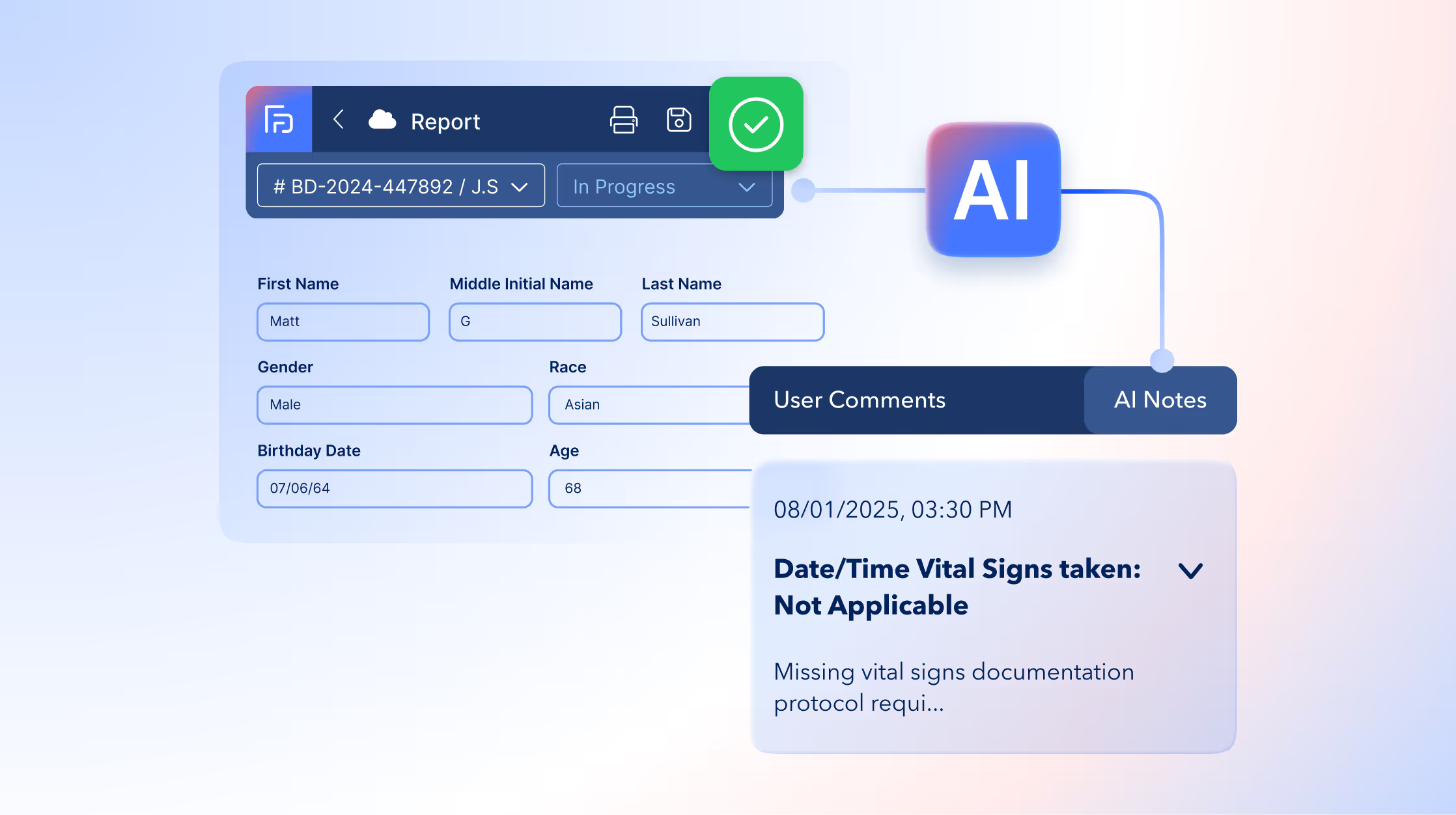
First Due's AI-powered ePCR captures information at the point of care through voice and photo, then populates the electronic patient care report — mapping to the appropriate NEMSIS values, and time-stamping who did what and when. It's NEMSIS-compliant, so a change to the standard is accounted for automatically; you're not chasing corrections on the back end.
Crucially, the provider is always in control. AI drafts; you review and override before anything is committed to the chart. As one way to put it: AI is not writing your chart — it's an assist, a tool in the toolbox for accuracy and speed.
The efficiency is real. Agencies adopting point-of-care AI documentation have reported charting times dropping sharply — in one department, from around 40 minutes a chart to roughly 14 — while QA/QI actually improved, because the data going in is cleaner.
"We went from about 40 minutes a chart to around 14 — and the charts got better, not worse." — EMS Documentation Lead, Mid-Size Transport Agency
Better Documentation Leads to Better Patient Care
When the ePCR is accurate and complete, the accurate information reaches the hospital — and patient care improves down the line. Providers get their time back, the record holds up, and the after-shift paperwork stops eating into rest and recovery.
The patient care report shouldn't be a memory test at the end of a hard shift. It should be a byproduct of the care you already delivered.
This is Step 5 of 9 in The Connected Journey, First Due's series on how one connected platform carries EMS from the schedule to the outcome. Go back to Step 4: The Hidden Value of Digital Preplans in EMS Response. Read the next step — Step 6: Patient Care Doesn't Stop During Transport—or at the Hospital Door.
Documentation will always be secondary to taking care of the patient. That's how it should be — and it's exactly why the patient care report has always come last.
For years, the ePCR got written at the hospital or back at the station, whenever there was finally time. By then, memory has done its work: on back-to-back-to-back calls, the details blur, and what you thought you heard isn't always what was said. Studies have found documentation errors that trace back to exactly this gap.
The fix isn't writing faster after the fact. It's capturing quality data at the point of care — while the call is happening.
The Patient Care Report Has Always Come Last
The problem with memory-based charting isn't effort. Crews work hard to get it right. The problem is that the human memory fades, and it runs together — which procedure, at what time, what the patient actually said. When the EMS patient care report is reconstructed hours later, small errors creep in, and small errors in a legal medical record are not small.
Good EMS charting systems have never struggled to store data. They've struggled to capture it accurately, at the moment it's true.
When You Document From Memory, the Record Suffers
Consider a long-term care transfer. The facility hands you two pages of medications on paper. There's rarely time to copy all of that down by hand during a call, so it gets summarized, approximated, or skipped — and the record to the hospital is thinner for it.
Multiply that across a busy shift and the pattern is clear: the harder the day, the worse the documentation, precisely when accurate patient care reporting matters most.
Moving the ePCR to the Point of Care
AI documentation moves capture to where the information actually lives — the scene. It isn't there to write your chart. It's there to gather what's said and done as it happens and organize it so the record reflects the call accurately.
You can have a normal conversation with the patient while the tool runs in the background, picking up the details. You can photograph a medication list or a page of past medical history at that long-term care facility and let the system read it, instead of transcribing two pages by hand. The result is a more accurate record, built from what really happened rather than what you remember.
How First Due Helps
First Due's AI-powered ePCR captures information at the point of care through voice and photo, then populates the electronic patient care report — mapping to the appropriate NEMSIS values, and time-stamping who did what and when. It's NEMSIS-compliant, so a change to the standard is accounted for automatically; you're not chasing corrections on the back end.
Crucially, the provider is always in control. AI drafts; you review and override before anything is committed to the chart. As one way to put it: AI is not writing your chart — it's an assist, a tool in the toolbox for accuracy and speed.
The efficiency is real. Agencies adopting point-of-care AI documentation have reported charting times dropping sharply — in one department, from around 40 minutes a chart to roughly 14 — while QA/QI actually improved, because the data going in is cleaner.
"We went from about 40 minutes a chart to around 14 — and the charts got better, not worse." — EMS Documentation Lead, Mid-Size Transport Agency
Better Documentation Leads to Better Patient Care
When the ePCR is accurate and complete, the accurate information reaches the hospital — and patient care improves down the line. Providers get their time back, the record holds up, and the after-shift paperwork stops eating into rest and recovery.
The patient care report shouldn't be a memory test at the end of a hard shift. It should be a byproduct of the care you already delivered.
This is Step 5 of 9 in The Connected Journey, First Due's series on how one connected platform carries EMS from the schedule to the outcome. Go back to Step 4: The Hidden Value of Digital Preplans in EMS Response. Read the next step — Step 6: Patient Care Doesn't Stop During Transport—or at the Hospital Door.