QA/QI That Closes the Loop Into Training (Part 8 of 9)


.svg)


In most EMS agencies, QA and QI come down to one person — maybe a QA officer, maybe the medical director — reviewing a slice of the calls. The critical ones. The high-acuity ones. A percentage.
It's not a failure of effort. In a busy system, reviewing every run by hand simply isn't possible. So things slip through the cracks — and crews learn, quietly, to document most carefully on the calls they know will be reviewed.
The gap isn't the reviewers. It's that EMS CQI has been built around sampling instead of the whole picture.
The Limits of Sampling
Today's review tends to focus where the risk is obvious: intubation and RSI, defibrillation, controlled-substance administration, cardiac arrest, major trauma, stroke and STEMI. Important calls, reviewed by a person, one at a time.
But that leaves the routine, high-volume calls largely unseen — and human nature does the rest. You tend to document more carefully when you know a chart is headed for QA. When you assume it isn't, the same rigor doesn't always follow.
When Only Some Charts Get Reviewed, Gaps Slip Through
A sample can't catch what it never looks at. Protocol deviations on ordinary calls, small internal contradictions, and documentation habits that would matter in a courtroom go unflagged simply because no one had time to open the chart.
And the small stuff has teeth. A narrative that says a 56-year-old male while the demographics say 59. The same set of vitals recorded three or four times in a row — possible, but unusual, and exactly the kind of inconsistency that invites doubt if a chart is ever examined. Individually minor; collectively, they undermine the credibility of the record.
"You document like someone's going to read it when you know QA will. The honest question is what the other calls look like." — QA/QI Officer, Third-Service EMS
Moving From Sampling to Every Chart
The change worth making is scope. Instead of reviewing a percentage, review everything — pairing automated review with human judgment so the routine screening happens at scale and people spend their time where their expertise counts.
That's the difference between QA/QI as a reactive chore and QA/QI as a continuous, closed-loop system that actually improves care.
How First Due Helps
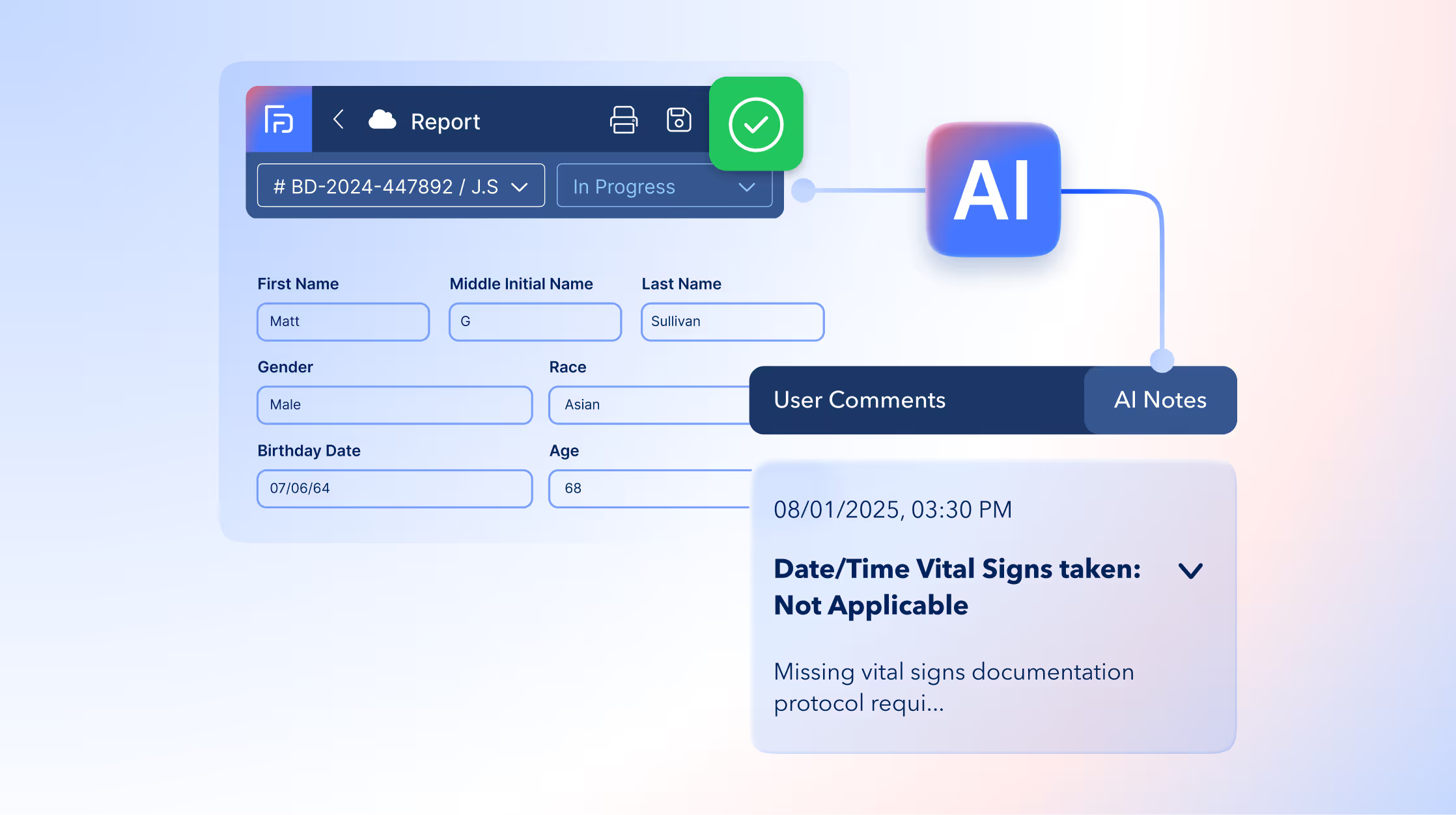
First Due's AI-assisted QA/QI runs 100% of charts through review, not just the critical few. It flags deviations from your protocols and surfaces discrepancies across the document — the age that doesn't match, the vitals that repeat, the details a human reviewer might miss on a busy day.
Feedback gets back to the crew quickly and clearly: red when something's wrong and needs an answer, yellow as a caution for next time, and green — the attaboy that EMS rarely hands out enough, for a difficult procedure handled well. Reviewers keep full control, including the ability to assign a chart up to the medical director or administrator when it warrants another set of eyes.
And when review finds a deficiency, it doesn't stop at a flag. The gap routes straight into scheduled training, so the finding becomes a fix.
Better Review Leads to Better Care
Reviewing every chart raises the floor on documentation quality, gives crews faster and fairer feedback, and turns quality improvement into something that compounds instead of resetting each month.
Closed-loop QA/QI is where review stops being paperwork and starts being a smarter training plan — and better patient outcomes.
This is Step 8 of 9 in The Connected Journey, First Due's series on how one connected platform carries EMS from the schedule to the outcome. Go back to Step 7: The Call Doesn't End at Handoff: Protecting the Crew. Read the next step — Step 9: Meeting the Standard of Care—Locally and Nationally.
In most EMS agencies, QA and QI come down to one person — maybe a QA officer, maybe the medical director — reviewing a slice of the calls. The critical ones. The high-acuity ones. A percentage.
It's not a failure of effort. In a busy system, reviewing every run by hand simply isn't possible. So things slip through the cracks — and crews learn, quietly, to document most carefully on the calls they know will be reviewed.
The gap isn't the reviewers. It's that EMS CQI has been built around sampling instead of the whole picture.
The Limits of Sampling
Today's review tends to focus where the risk is obvious: intubation and RSI, defibrillation, controlled-substance administration, cardiac arrest, major trauma, stroke and STEMI. Important calls, reviewed by a person, one at a time.
But that leaves the routine, high-volume calls largely unseen — and human nature does the rest. You tend to document more carefully when you know a chart is headed for QA. When you assume it isn't, the same rigor doesn't always follow.
When Only Some Charts Get Reviewed, Gaps Slip Through
A sample can't catch what it never looks at. Protocol deviations on ordinary calls, small internal contradictions, and documentation habits that would matter in a courtroom go unflagged simply because no one had time to open the chart.
And the small stuff has teeth. A narrative that says a 56-year-old male while the demographics say 59. The same set of vitals recorded three or four times in a row — possible, but unusual, and exactly the kind of inconsistency that invites doubt if a chart is ever examined. Individually minor; collectively, they undermine the credibility of the record.
"You document like someone's going to read it when you know QA will. The honest question is what the other calls look like." — QA/QI Officer, Third-Service EMS
Moving From Sampling to Every Chart
The change worth making is scope. Instead of reviewing a percentage, review everything — pairing automated review with human judgment so the routine screening happens at scale and people spend their time where their expertise counts.
That's the difference between QA/QI as a reactive chore and QA/QI as a continuous, closed-loop system that actually improves care.
How First Due Helps
First Due's AI-assisted QA/QI runs 100% of charts through review, not just the critical few. It flags deviations from your protocols and surfaces discrepancies across the document — the age that doesn't match, the vitals that repeat, the details a human reviewer might miss on a busy day.
Feedback gets back to the crew quickly and clearly: red when something's wrong and needs an answer, yellow as a caution for next time, and green — the attaboy that EMS rarely hands out enough, for a difficult procedure handled well. Reviewers keep full control, including the ability to assign a chart up to the medical director or administrator when it warrants another set of eyes.
And when review finds a deficiency, it doesn't stop at a flag. The gap routes straight into scheduled training, so the finding becomes a fix.
Better Review Leads to Better Care
Reviewing every chart raises the floor on documentation quality, gives crews faster and fairer feedback, and turns quality improvement into something that compounds instead of resetting each month.
Closed-loop QA/QI is where review stops being paperwork and starts being a smarter training plan — and better patient outcomes.
This is Step 8 of 9 in The Connected Journey, First Due's series on how one connected platform carries EMS from the schedule to the outcome. Go back to Step 7: The Call Doesn't End at Handoff: Protecting the Crew. Read the next step — Step 9: Meeting the Standard of Care—Locally and Nationally.
.avif)