Leading the NERIS Transition: Nearly Half of All Reports Start with First Due

.avif)

.svg)


The National Emergency Response Information System (NERIS) represents one of the most important evolutions in the history of the fire service. Built through the U.S. Fire Administration under FEMA, NERIS replaces NFIRS as the national standard for fire data collection and submission. It is designed to modernize how data is captured, shared, and analyzed to improve operations and firefighter safety while supporting national research through collaboration with FEMA and the Fire Safety Research Institute (FSRI).
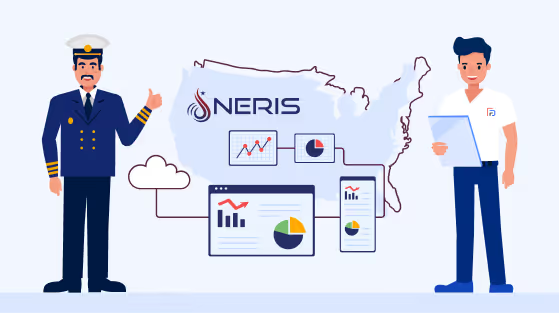
NERIS connects every level of the fire service through a single data pipeline. It enables departments to report in real time, ensures consistent data validation, and provides federal agencies with the quality information they need to make data-driven decisions. For the first time, agencies can see the direct impact of their reports at the state and national levels.
The transition from NFIRS to NERIS is already underway, and thousands of agencies are preparing for their state deadlines. While many vendors are still developing their rollout strategies, First Due is already powering the transition at scale. Nearly half of all NERIS reports in the country are being submitted through First Due, proving that the platform and its customers are leading the way forward.
The Challenge: Complex Change Across Every Level
The shift from NFIRS to NERIS is not a simple software update. It is a complete reengineering of how fire data is structured, validated, and delivered. NERIS introduces new schema designs, stricter validation rules, and real-time API-based submissions that require modern, cloud-based technology.
For vendors that rely on on-premise systems, these requirements have exposed significant limitations. Older systems struggle to process real-time data exchanges, and many vendors have delayed their rollouts to buy time. Some have even positioned their slow progress as a deliberate strategy, calling it a “thoughtful transition.”
In reality, these delays are the result of outdated infrastructure. They leave departments facing long implementation timelines, uncertainty about compliance, and potential risk of missing their state’s NERIS deadlines. When this happens, agencies may experience data overlap between NFIRS and NERIS, duplicate entries, or even data loss during the transition period.
These challenges come with operational and administrative consequences. Departments must dedicate extra staff hours to fix rejected reports, resubmit data, or reconcile missing information. For agencies that rely on complete reporting to secure grants or meet state mandates, falling behind is not an option.
NERIS readiness is not just a technical milestone. It is a critical operational requirement.
The First Due Advantage: Ready Before the Rest
First Due began preparing for NERIS before its official launch. By working directly with FEMA and FSRI during the early planning and development stages, First Due ensured that its platform architecture was fully aligned with the new national data standard.
This proactive approach means that agencies using First Due are not just ready for NERIS, they are already live and reporting. The results speak for themselves. Nearly half of all NERIS submissions to date have originated from First Due (42%+ at the time of publication), with nearly 200,000 successful submissions and close to 1,000 agencies already transitioned at the time of this writing. Thousands more will make the switch over the coming weeks through a simple one-click transition process.
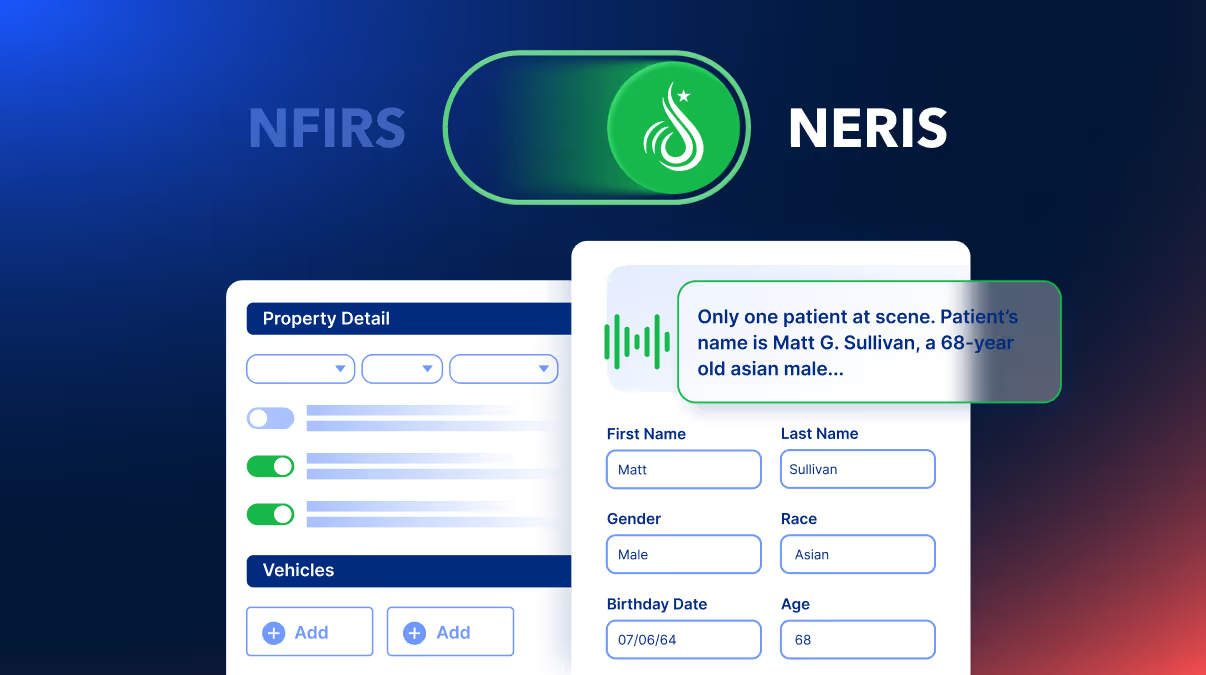
Because First Due is fully cloud native, agencies can transition from NFIRS to NERIS instantly, without complicated migrations or third-party dependencies. The process is simple, fast, and validated in real time, ensuring that reports are complete, accurate, and compliant from the start.
While other vendors are still developing, testing, or troubleshooting, First Due agencies are already reporting seamlessly to FEMA’s national system. This early leadership demonstrates not only technical readiness but also the trust agencies have in First Due’s platform and team.
Collaboration That Strengthens the Fire Service
The success of NERIS depends on a strong partnership between technology vendors and the federal program. Together, they are reshaping how fast and how accurately data moves through the fire service.
Under NFIRS, data often took weeks or months to reach state and federal systems. Agencies had to export files, send them manually, and wait for batch uploads to be verified. Errors were common, and data quality suffered. With NERIS, that process has been transformed. Validated data can now move from a department’s RMS to the national database within hours.
This new level of collaboration between technology vendors and federal partners has fundamentally improved how data flows through the system. State program managers can now monitor submissions in real time, identify anomalies, and focus on data quality instead of clerical processing. Federal analysts and research teams can use the incoming data stream to identify trends and emerging risks faster than ever before.
FEMA and FSRI use this new data ecosystem to power national studies, identify risk patterns, and guide community risk reduction strategies. From tracking the rise of e-mobility and lithium-ion battery incidents to studying the effectiveness of new suppression tactics, the data supplied by agencies reporting through First Due plays a critical role in driving national research and safety initiatives.
From Local Operations to Federal Impact
The transition to NERIS has created a unified data pipeline that benefits every level of the fire service. Information that once moved slowly and inconsistently now travels seamlessly from the incident scene to state offices and federal systems.
At the local level, departments using First Due are connecting incident documentation to the rest of their operational ecosystem. Every report ties directly into occupancy records, inspections, pre-plans, and training data, giving departments a full view of their community risk and operational readiness. This integrated approach eliminates silos and provides decision-makers with the context they need to act quickly and effectively.
At the state level, fire program administrators can see accurate, up-to-date information on reporting activity and compliance. Instead of relying on quarterly or annual uploads, they now have access to live dashboards that reveal real-time trends across all agencies.
At the federal level, FEMA and FSRI can analyze incident patterns across the nation, detect emerging hazards, and measure the effectiveness of safety initiatives. This continuous feedback loop allows the fire service to learn from every incident, improve firefighter safety, and strengthen community outcomes.
Through First Due, every local report contributes to the national mission. The data collected through First Due not only meets compliance requirements but also fuels research, funding decisions, and prevention strategies that protect communities nationwide.
Why Readiness Matters Now
NERIS is no longer a concept on the horizon. It is here, and the deadlines are real. State by state, agencies are being asked to transition, and many are already live. The departments that wait risk falling behind on compliance, losing critical data, or missing grant opportunities tied to complete and timely reporting.
Agencies using First Due are already operating within the new standard. Their transitions were fast, their reports are compliant, and their data is live within the federal system. This readiness gives them an immediate advantage, not only in meeting state requirements but in using the data to enhance their own operational intelligence.
While other vendors are still preparing to adapt, First Due customers are already shaping the future of fire data. They are proving that with the right partner, modernization is not disruptive. It is empowering.
Leading the Industry Forward
The NERIS transition has become a clear dividing line between vendors that were built for the past and those built for the future. First Due’s leadership in this space is a result of preparation, collaboration, and innovation that began before the first state rollout.
By working directly with FEMA and FSRI, First Due helped shape the foundation of modern fire data collection. The company continues to innovate beyond compliance, using NERIS data to power insights, analytics, and AI-driven reporting tools that help agencies improve their daily operations.
Every agency that partners with First Due gains access to an integrated ecosystem that brings together incident reporting, community risk reduction, pre-plans, training, and analytics in one platform. This connection ensures that every piece of information captured during an incident can be used to drive smarter prevention, response, and recovery efforts.
First Due is not just leading the transition. It is defining what readiness, reliability, and leadership look like in the modern fire service.
Powering the Future of Fire Data
The NERIS transition represents a milestone for the entire fire service. It connects every department to a national network of real-time data that drives research, safety, and smarter decision-making.
With nearly half of all NERIS reports already First Due born, the results show that readiness is not an aspiration. It is a proven reality. First Due’s partnership with FEMA, FSRI, and agencies across the country ensures that every report strengthens the collective knowledge of the fire service.
The future of fire data is here. It is connected, collaborative, and built on trust. And it starts with First Due.
The National Emergency Response Information System (NERIS) represents one of the most important evolutions in the history of the fire service. Built through the U.S. Fire Administration under FEMA, NERIS replaces NFIRS as the national standard for fire data collection and submission. It is designed to modernize how data is captured, shared, and analyzed to improve operations and firefighter safety while supporting national research through collaboration with FEMA and the Fire Safety Research Institute (FSRI).
NERIS connects every level of the fire service through a single data pipeline. It enables departments to report in real time, ensures consistent data validation, and provides federal agencies with the quality information they need to make data-driven decisions. For the first time, agencies can see the direct impact of their reports at the state and national levels.
The transition from NFIRS to NERIS is already underway, and thousands of agencies are preparing for their state deadlines. While many vendors are still developing their rollout strategies, First Due is already powering the transition at scale. Nearly half of all NERIS reports in the country are being submitted through First Due, proving that the platform and its customers are leading the way forward.
The Challenge: Complex Change Across Every Level
The shift from NFIRS to NERIS is not a simple software update. It is a complete reengineering of how fire data is structured, validated, and delivered. NERIS introduces new schema designs, stricter validation rules, and real-time API-based submissions that require modern, cloud-based technology.
For vendors that rely on on-premise systems, these requirements have exposed significant limitations. Older systems struggle to process real-time data exchanges, and many vendors have delayed their rollouts to buy time. Some have even positioned their slow progress as a deliberate strategy, calling it a “thoughtful transition.”
In reality, these delays are the result of outdated infrastructure. They leave departments facing long implementation timelines, uncertainty about compliance, and potential risk of missing their state’s NERIS deadlines. When this happens, agencies may experience data overlap between NFIRS and NERIS, duplicate entries, or even data loss during the transition period.
These challenges come with operational and administrative consequences. Departments must dedicate extra staff hours to fix rejected reports, resubmit data, or reconcile missing information. For agencies that rely on complete reporting to secure grants or meet state mandates, falling behind is not an option.
NERIS readiness is not just a technical milestone. It is a critical operational requirement.
The First Due Advantage: Ready Before the Rest
First Due began preparing for NERIS before its official launch. By working directly with FEMA and FSRI during the early planning and development stages, First Due ensured that its platform architecture was fully aligned with the new national data standard.
This proactive approach means that agencies using First Due are not just ready for NERIS, they are already live and reporting. The results speak for themselves. Nearly half of all NERIS submissions to date have originated from First Due (42%+ at the time of publication), with nearly 200,000 successful submissions and close to 1,000 agencies already transitioned at the time of this writing. Thousands more will make the switch over the coming weeks through a simple one-click transition process.
Because First Due is fully cloud native, agencies can transition from NFIRS to NERIS instantly, without complicated migrations or third-party dependencies. The process is simple, fast, and validated in real time, ensuring that reports are complete, accurate, and compliant from the start.
While other vendors are still developing, testing, or troubleshooting, First Due agencies are already reporting seamlessly to FEMA’s national system. This early leadership demonstrates not only technical readiness but also the trust agencies have in First Due’s platform and team.
Collaboration That Strengthens the Fire Service
The success of NERIS depends on a strong partnership between technology vendors and the federal program. Together, they are reshaping how fast and how accurately data moves through the fire service.
Under NFIRS, data often took weeks or months to reach state and federal systems. Agencies had to export files, send them manually, and wait for batch uploads to be verified. Errors were common, and data quality suffered. With NERIS, that process has been transformed. Validated data can now move from a department’s RMS to the national database within hours.
This new level of collaboration between technology vendors and federal partners has fundamentally improved how data flows through the system. State program managers can now monitor submissions in real time, identify anomalies, and focus on data quality instead of clerical processing. Federal analysts and research teams can use the incoming data stream to identify trends and emerging risks faster than ever before.
FEMA and FSRI use this new data ecosystem to power national studies, identify risk patterns, and guide community risk reduction strategies. From tracking the rise of e-mobility and lithium-ion battery incidents to studying the effectiveness of new suppression tactics, the data supplied by agencies reporting through First Due plays a critical role in driving national research and safety initiatives.
From Local Operations to Federal Impact
The transition to NERIS has created a unified data pipeline that benefits every level of the fire service. Information that once moved slowly and inconsistently now travels seamlessly from the incident scene to state offices and federal systems.
At the local level, departments using First Due are connecting incident documentation to the rest of their operational ecosystem. Every report ties directly into occupancy records, inspections, pre-plans, and training data, giving departments a full view of their community risk and operational readiness. This integrated approach eliminates silos and provides decision-makers with the context they need to act quickly and effectively.
At the state level, fire program administrators can see accurate, up-to-date information on reporting activity and compliance. Instead of relying on quarterly or annual uploads, they now have access to live dashboards that reveal real-time trends across all agencies.
At the federal level, FEMA and FSRI can analyze incident patterns across the nation, detect emerging hazards, and measure the effectiveness of safety initiatives. This continuous feedback loop allows the fire service to learn from every incident, improve firefighter safety, and strengthen community outcomes.
Through First Due, every local report contributes to the national mission. The data collected through First Due not only meets compliance requirements but also fuels research, funding decisions, and prevention strategies that protect communities nationwide.
Why Readiness Matters Now
NERIS is no longer a concept on the horizon. It is here, and the deadlines are real. State by state, agencies are being asked to transition, and many are already live. The departments that wait risk falling behind on compliance, losing critical data, or missing grant opportunities tied to complete and timely reporting.
Agencies using First Due are already operating within the new standard. Their transitions were fast, their reports are compliant, and their data is live within the federal system. This readiness gives them an immediate advantage, not only in meeting state requirements but in using the data to enhance their own operational intelligence.
While other vendors are still preparing to adapt, First Due customers are already shaping the future of fire data. They are proving that with the right partner, modernization is not disruptive. It is empowering.
Leading the Industry Forward
The NERIS transition has become a clear dividing line between vendors that were built for the past and those built for the future. First Due’s leadership in this space is a result of preparation, collaboration, and innovation that began before the first state rollout.
By working directly with FEMA and FSRI, First Due helped shape the foundation of modern fire data collection. The company continues to innovate beyond compliance, using NERIS data to power insights, analytics, and AI-driven reporting tools that help agencies improve their daily operations.
Every agency that partners with First Due gains access to an integrated ecosystem that brings together incident reporting, community risk reduction, pre-plans, training, and analytics in one platform. This connection ensures that every piece of information captured during an incident can be used to drive smarter prevention, response, and recovery efforts.
First Due is not just leading the transition. It is defining what readiness, reliability, and leadership look like in the modern fire service.
Powering the Future of Fire Data
The NERIS transition represents a milestone for the entire fire service. It connects every department to a national network of real-time data that drives research, safety, and smarter decision-making.
With nearly half of all NERIS reports already First Due born, the results show that readiness is not an aspiration. It is a proven reality. First Due’s partnership with FEMA, FSRI, and agencies across the country ensures that every report strengthens the collective knowledge of the fire service.
The future of fire data is here. It is connected, collaborative, and built on trust. And it starts with First Due.
.avif)

.avif)